|
THE ATHENS CONCERT HALL - MEGARON MOUSIKIS
ATHINON: ANDREAS GEORGIOU AND THE ETHNIC JAZZ TRADITION
The music of Andeas Georgiou is placed in the
framework of the so-called ethnic jazz implying a form of
ethnic music which incorporates elements from the traditions
of several musical cultures such as:
- Melodic, harmonic and rhythmic features and often loans
of unedited traditional melodies.
- Traditional musical instruments. Georgiou has been experimenting
extensively with the use of various traditional instruments
in his own music such as, among others, the Greek tambura,
the Cretan mantoura, the Cyprian pithkiavli, the Indian
sitar and shahnay and the African sansa.
- The different approach of the very act of a musical performance
(i.e. the importance of the season of the year and the time
of the day during which a raga should be played to the people
of India).
It is important to be stressed right from the outset that
the use of the above elements is by no means binding. The
objective pursued is not the precise production of the music
patterns but the expansion of expressive potential and the
enrichment of the final musical output.
A distinctive feature of ethnic music is the freedom of
use as regards the material that is summoned up. When traditional
music is played in its authentic mode it is not ethnic music.
It is instead the so-called world music.
The ethnic approach on jazz dates back to the end of the
50s. The first substantial ethnic approach was the so-called
bosa nova, a new Latin American rhythm created by Joao Gilberto
The success of the "'Orfeu negro" film, which
was released in the 50s, contributed to the popularity and
the dissemination of this rhythm as well as of the Latin
American music in general. In the same year, Gilberto released
the epic album "Chega de sausade" introducing
bosa nova, a new kind of more relaxed samba combined with
lush jazz harmonies.
This new rhythm had soon a major impact. However, it is
most important the fact that this turn toward Brazil's music
signalled the beginning of the study of other musical cultures
such as Africa's and India's which eventually had a considerable
influence to the western world.
All the above had a significant impact on Georgiou's music,
too. His collaboration with Airto Moreira , the leading
Brazilian percussionist, is most crucial. Africa is echoed
in many of his compositions as it is often evidenced by
the titles of his works. Andreas has been definitively influenced
by India's cosmic approach to the origin of the universe.
Nevertheless, if the ethnic approach to music is characterized
by the tendency for experimentation, this tendency in Georgiou's
music is not limited only by the traditional ethnic aesthetics
but it expands to encompassing many other elements. His
experimentation with various instruments, which is generated
by the need for the expansion of the expressive potential
of his music, is distinctive.
As already said, Georgiou uses to this purpose various traditional
instruments. Yet, the most important one was the construction
of a guitar which he invented.
In his own words: "Almost from the beginning of my
career, in 1980, I had set certain goals. As a result in
1982 I invented my own 16-string guitar. This guitar did
not exist anywhere until that time. I had contemplated on
how I should apply certain harmonic systems as well as produce
multiple rhythms at the same time so that the guitar could
assume a different identity [...] It's just a different
instrument which in fact I had been studying for many years
[...] Still new questions were raised again and again such
as: what could be the configuration or the arrangement of
the strings so to speak. Thus I experimented with different
tunings".
Georgiou's tendency for exploring different music capabilities
finds a wider expression in the sector of orchestration
whereas his relevant musical pursuits have been developing
from album to album.
In conclusion, his music is characterised by the harmonious
co-existence of influences from different worlds (each one
of which he explores in its entirety):
- From jazz with its intensive rhythms and the ingenious
improvisation which is based on the utilization of any musical
element.
- From traditional music.
- From classical European music, where his music is rooted,
as it is often the case in contemporary jazz. His studies
include also Byzantine music, which is a form of eastern
classical music, an element that is easily detected in his
work.
In general, Georgiou's music relies primarily on the rhythmic
element insomuch that it calls to mind rather the traditional
jazz although it's sound is quite different.
His compositions, which are dominated by the melodic element,
are fewer. Their inner strength though is far greater. Their
essential asset is the use of simple melodies which render
greater immediacy. Besides, artistic creation aims at approaching
simplicity which characterises whatever is beautiful.
DIONYSIS BOUKOUVALAS
GUITAR SUMMIT: ANDREAS GEORGIOY
Although Andreas Georgiou's performance drifts
from acoustic guitars (of 15 or 16 strings) to the electric
guitar, from solo to the small ensemble as well as the free-traditional
jazz mix of the 80s (including the dual aspect of the jazz
of this period) he seems to disregard this transition. The
process he follows is characterized especially by his sense
of listening, dialogue and a tendency to search for (and find)
a natural ecology of sounds.
JEAN-CLAUDE QUEROY, "ECOUTER
VOIR" musical magazine
MARDEL JAZZ: AIRES
DE RENOVACION
[...] This is the case of Andreas Georgiou, who has marvelously
depicted this primeval music which diffuses its resonances
in various cultures of the Old World.
Andreas, using different guitars (acoustic and electric) along
with the Indian sitar, the shahnay, the African mbira, marimbula
and various percussion instruments, dives into the roots of
the Greek modes in a rhythmic pulse which echoes dances of
millennia.
Andreas returns with unction and merriment to this territory
which from the Aegean Sea was launched to the entire world
a music system that was enriched in the course of centuries.
It's a ceaseless back and forth, a miraculous journey guided
only by the hand of the chosen.
Mar del Jazz seems to find in this group of the protagonists
its reason of existence.
Rene Vargas Vera
"LA NACION" ARGENTINA
|
CD Reviews
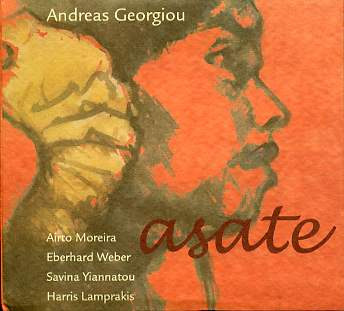 |
Asate
LM028-2
Available from CD Baby.
A review written for the Folk & Acoustic Music Exchange
by Mark S. Tucker
(progdawg@hotmail.com).
|
I've noted Andreas Georgiou's CD background here, here, and here,
so this time I'll jump straight into the virtues of this disc, which
ushers back Eberhard Weber and inducts Airto Moreira and Savina
Yiannatou, also luminaries in the chamber jazz / ECM worlds (Moreira
possessing an even longer history, a years-past alum of the illustrious
CTI label and a very in-demand percussionist). The disc is of a piece
with everything else Georgiou has done, and not a single cut in any of
his many releases veers one inch from the highest standards.
Where Paul McCandless appeared with his sax on Jua Ni Juu,
Harris Lamprakis plays the caval, a flute, here on two cuts redoubling
very strong Grecian, Mediterranean, and even Arabic airs. Yiannatou
dubs in her angelic melismas, and Moreira is as lush and ingenious as
he's ever been. Georgiou has a way of bringing that out even in already
hallowed stalwarts, his compositions and shimmering guitar playing
re-mounting a drive to perfection that has been sadly decaying in much
of the music world in toto in the last couple decades.
Relying
mainly on his beloved 15- and 16-string axes, he also pulls in a
standard classical guitar and plies it in several spots. While I've
referred to the many more other well-known moderns he sits well with, I
should also mention that his inventions are kindred to Michael Hedges'
ground-breaking work and sit beautifully with the CandyRat label boys,
lads and gents who are breaking the ground for the guitar's next
milieu. Ah, but there's one more, a long-forgotten ace: Alain
Markusfeld, who issued only a few European LPs and, if memory serves
correctly, sat in here and there and then disappeared after fusing the
old and new in ways that were then (late 70s & early 80s) not
widely accepted. The guy was an unorthodox virtuoso and so is Georgiou.
Weber
gets some great solos, Georgiou plays like a demon, and Yiannatou is
extremely pleasant, but Moreira almost steals the show. His work in Rainforest
is incredible but the rest of the showcase spots him just as
impressively. The guitarist couldn't have chosen a more suitable
accompanist, and one can only hope that future works will bring Airto
back again.
Track List:
- Nea Selini (3:53)
- Dhoro Exagnismou (3:23)
- Let the Spirit Flower (7:00)
- Rainforest (10:54)
|
- Anthos Porfiron (2:46)
- ISA (10:30)
- Asate (8:37)
- Sukuma Twende (4:50)
|
| All songs written and orchestrated by Andreas Georgiou. |
Edited by: David N. Pyles
(dnpyles@acousticmusic.com)
Copyright 2009, Peterborough Folk Music Society.
This review may be reprinted with prior permission and attribution.
|
|
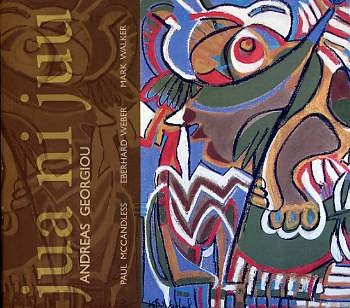 |
Jua Ni Juu
CON 1087
Available from CD Baby.
A review written for the Folk & Acoustic Music Exchange
by Mark S. Tucker
(progdawg@hotmail.com).
|
For a bit of commentary on Andreas Georgiou's wherewithal, refer to the review of Modus Vivendi (here), a release concentrating heavily on his gifts as a guitarist. This release, Jua Ni Juu,
reveals his facility in ensemble work with fellow masters Eberhard
Weber and Paul McCandless. Weber is responsible for one of the
landmarks of chamber jazz, the incomparable Colors of Chloes
on the pristine ECM label, and McCandless was a founding member of the
seminal world music group Oregon, another ECM staple. If its not
already obvious, the point is that once you've made it to the estimable
Editions of Contemporary Music, there's nowhere else to go, you've
reached the top, and, to be honest, this disc is worthy of immediate
induction into that nirvana.
Jua Ni Juu
vividly recalls the wild, woolly, heady days of Manfred Eicher's
earliest masterpieces, the times when Keith Jarrett, Ralph Towner, John
Abercrombie, Jan Garbarek, Terje Rypdal, and a panoply of others were
busy fusing the folk, classical, jazz, and progressive genres into a
new music form. Jua is musically literate in
the stratospheric sense and can't help but evoke a step backwards to
when the barriers-breaking spirit of the 60s and 70s still infected the
arts, a time when quality and intelligence were hallmarks, not
coincidences. Georgiou's guitar work here is fulsome and atmospheric
while McCandless turns in one of his most arresting performances
outside Oregon, Weber accompanying both with a melodically
equal-tempered bass demonstration.
Mark
Walker turns in an infinitely engaging session on drums and percussion,
a combination of Jack DeJohnette, Jon Christensen, and Jeff Williams
(Dave Liebman's old sticksman) in a rare example of exactly why drums
shouldn't be merely the metronomic adjunct of an ensemble—in the hands
of a visionary, they partner equally in the musical conversation.
What's most surprising, though, is Georgiou's turn to the electric
guitar in the middle of Jua a Furaha, a
rock-fundamented solo that finds its closest contemporary in the Sky
releases (featuring John Williams and Kevin Peek) as it welds Fripp
with Santana and Abercrombie.
The
four cuts here are orgies of artistic imagination and Renaissance
entablature, long tapestries of old and new country vistas, spirited
pastorales acting like opium dreams for the listener fortunate enough
to run across them. If you've been longing for the good old days when
you could hardly wait for the next ECM release, the age when the label
wasn't enmeshed in weird business contretemps and screwed by
pelican-brained imbeciles among the functionaries, then that longing is
now fulfilled, here, in this and the many other CDs being issued by
Andreas Georgiou.
Track List:
- Kua Ni Juu (10:53)
- Jua a Furaha (9:56)
- Jua Ni Kuchwa (9:17)
- Shauri Yia Mungi (21:39)
|
| All songs written by Andreas Georgiou. |
Edited by: David N. Pyles
(dnpyles@acousticmusic.com)
Copyright 2009, Peterborough Folk Music Society.
This review may be reprinted with prior permission and attribution.
|
|
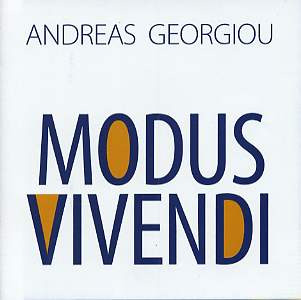 |
Modus Vivendi
CON 1089
No online source found for this 1994 release
A review written for the Folk & Acoustic Music Exchange
by Mark S. Tucker
(progdawg@hotmail.com).
|
Though
virtually unknown on these shores, Andreas Georgiou is a master
guitarist who has—through not only unorthodox and innovative approaches
but also deeply traditional reverences to the instrument—managed to
attract some of the cream of the European chamber jazz establishment to
his recordings, particularly Eberhard Weber, Paul McCandless, and
Savina Yannatou, though they don't appear here. Even just the briefest
listen to this CD illustrates why, however, they readily flock to his
work.
Georgiou plays 15 and 16-string
guitars (as well as a standard electric), instruments sporting a
fretboard wider than most men's forearms and, thus, not always the
easiest axe to grapple, though he makes it seem as though such were
childplay, his fingers disporting themselves a la Ralph Towner, Egberto
Gismonti, Alain Markusfeld, or any of the most accomplished fretsmen.
To listen to Georgiou's work is to understand the wider implications of
the possibilities of the instrument. Modus Vivendi
is basically a solo performance augmented occasionally by Dimitris
Karaganis' flute and sax, but, hearing Karaganis, it's evident why the
guitarist would then attract McCandless: only the most conceptually
adept could possibly work in tandem with him.
More
arrestingly, the entire CD was recorded live in straight takes with no
overdubs, the equivalent of older documents from LP audiophile labels
that presented immaculately recorded two-track of-the-moment events
breathtaking for their vivacity and freshness. Modus Vivendi
indexes perfectly with those. At no point in the entire recital are his
powers less than extremely impressive. Even the simplest passages ring
with nuance and authority while the complex runs and chordings are
luxurious and mesmerizing. This CD, and every single release by
Georgiou, is an immersion in modern classical structuring and
post-classicalist thought and exposition…nonetheless clearly retaining
the timelessness of long bygone days.
Track List:
- Gyula's Systea (5:17)
- Modus Vivendi (12:29)
- Nostalgia (6:33)
- Pragmatism (4:32)
- Sunshine (6:54)
|
- Andro's Systema (5:17)
- Stile me Mana sto Nero (3:17)
- Painters II (2:48)
- Space-Time Continuum (5:28)
|
| All songs written by Andreas Georgiou except Stile me Mana sto Nero (traditional. arr. by Georgiou). |
Edited by: David N. Pyles
(dnpyles@acousticmusic.com)
Copyright 2009, Peterborough Folk Music Society.
This review may be reprinted with prior permission and attribution. |
|
 |
|
I'm
running out of adjectives and adverbs to adequately encompass Andreas
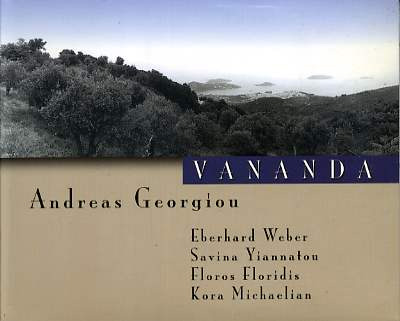
Georgiou's blindingly brilliant work. Having run through the marvelous Jua Ni Juu, Asate, and Modus Vivendi, Vananda
now makes its way to the fore and features not just the usual stellar
sessioneers but also the Yeravan Symphonic Orchestra. Does this guy
never stop topping himself?!?!
A strong side attraction here is Floros Floridas' spectacular but unfortunately brief sax work on two cuts, especially Constantia,
a direct correlate to Paul McCandless' legendary prowess and, to my
ears, infused with an outside edge not unlike Steve Lacy's (whom I
strongly suspect McCandless also found inspiration in). Eberhart
Weber's back, thank goodness, as his colorations are inimitably
complementary to Georgiou's playing and composing, as is Savina
Yiannatou with her gently vaulting wordless vocals. Pianist Kora
Michaelian joins in on a pair of tracks to add a ghostly dimension in
tonal / atonal tinklings and ornamentation.
Three cuts here harken back to Modus Vivendi, two duets with Weber and a solo from the bassist. Gathering
sounds akin to Alex Skolnik and Stanley Clarke popping, pinging, and
pizzicato'ing their nimble fingers off, then Georgiou switches to a
highly abstract Ralph Towner mode and Weber keeps the burbling
skittering bass pyrotechnics going. For over 15 minutes, they keep up
an interplay that's terrifyingly agile and as beautifully chaotic as
Picasso's Guernica until settling into a long tranquil mid-section that's a cornucopia of stylistic improv.
Lament, at the close of the disc, is another duet, this time arising from a spectral landscape eerily similar to some of Towner's Solstice
work, a chiaroscuro of Penderecki-esque creepiness and poltergeists.
The guitar sounds like a bass, and the bass becomes an unsettling
creature far off in the dark. Somehow the two also manage to convert
their axes (5-string electric bass, fretless electric guitar) to a
shenai and tanpura! Don't ask me how. Bowing? I couldn't say but it's
unreal, absolutely amazing. Once again, Georgiou is singlehandedly
resurrecting the high period of ECM, and if that alone isn't reason to
check into his work, then I'm completely stumped as to what it will
take.
Track List:
- Constantia (Composer: Georgiou / Orchestrator: Georgiou) (6:37)
- Vananda (Composer: Georgiou / Orchestrator: Kora Michaelian) (3:52)
- Gathering (Georgiou / Weber) (15:32)
- Knowledge (Composer: Georgiou / Orchestrator: Georgiou) (1:50)
- Afro (Composer: Georgiou / Orchestrator: Georgiou / Michaelian) (12:47)
- Crossing the Nile (Composer: Georgiou / Orchestrator: Michaelian) (2:59)
- Lament (Andreas Georgiou) (17:30)
|
Edited by: David N. Pyles
(dnpyles@acousticmusic.com)
Copyright 2009, Peterborough Folk Music Society.
This review may be reprinted with prior permission and attribution.
|
|
|
|
|
|